When you cover your face with your hands, peeking out from between your fingers, or screw up your face into a parody of itself, you become, for the briefest of moments, someone else. You’re recreating the oldest masks in history; ones that, from the beginning of time, have protected concealed, frightened, or delighted all humankind.
Throughout the ages, masks have starred in Greek drama, sent men roaring down the warpath, summoned otherworldly spirits, and figured in initiation, healing, and funereal rites. Masks have also masked a multiplicity of duplicity.
For centuries, La Serenissima, The Most Serene Republic of Venice, controlled sea trade between Europe and the East. Venetian masks

This wealthy port city, bustling with people from near and far, hosted an array of attractions, gambling dens, musical performances, acrobatic shows, wine shops, and brothels. It was also a whirlpool of crime, illicit encounters, and intrigue.
As far back as the 11th century, masks, worn during the pre-Lenten Carnival of Venice and other periods, allowed people from all walks of life to mingle freely. Stripped of their identifying features, courtesans and commoners, princes and priests, all could dilly or dally as the mood moved them. By the mid 1400s, disguises had become such an integral part of the Venetian way of life that mask makers followed their own laws and were awarded their own guild. With the fall the Republic of Venice in 1798, however, the Carnival fell into decline.
Today, thanks to a group of enterprising Venetian art students, the Carnival of Venice has been born anew. Once again merrymakers wander the city’s streets in fanciful disguises. Most modern Venetian artists create masks using time honored, traditional techniques. They fill traditionally-shaped hand-sculpted clay molds with chalky gesso, forming a negative image, the mask itself. Then they plaster the gesso with papiér-mâche and adorn their creations.
The classic v-shaped Bauta mask, combined with a long robe, a cloak, and a three-cornered hat, offers complete anonymity. Though it covers the entire face, its tilted chin skims the mouth, allowing its wearer to eat, drink, speak, and socialize with ease.
The gnaga, a cat mask, was once reserved for young men disguised as women. These tomcats were known for their vulgarity. In fact, the more vulgar their speech, typically uttered in anonymous falsettos, the more the crowds crowed. Gnagas who prowl Venice today, however, both male and female, are far tamer.
The volto, another traditional mask, covers the entire face. Its wide, rounded surface allows artists any number of expressions and embellishments. Venetian masks Variations on the basic volto, masks that cover one eye and half the face, or just the upper portion of the face, are also popular.
The Columbina eye mask, available in a rainbow of colors, immortalizes clever, crafty Columbine, a stock character of Italy’s Commedia dell’arte, the “art of comedy.” Then like now, Commedia dell’arte traveling troupes appeared in open town squares, delighting crowds with acrobatic tricks, music, bouts of jugglery, and buffoonery. They also presented improvised slapstick skits depicting universal themes like jealousy, adultery, and love.

Mischievous Harlequin is another Commedia character immortalized in masks. The signature, multi-colored diamond shaped patterns that grace his costume regularly appear on bautas, voltos, and columbinas. Beloved Pierrot, charming in loose, white pantaloons and neck ruff, often appears in full-face masks, an expressive tear coursing down his cheek. Roguish Pulcinella, whose hooked nose almost meets his chin, is another familiar Carnival sight. So is black-clad, scheming Scaramouche, whose nose is longer still.
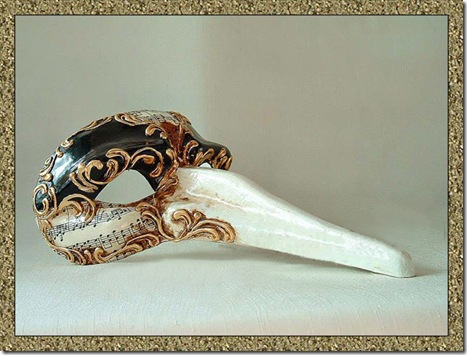
Commedia aside, masked noses also figured prominently during the 1629 scourge of Venice, the black plague. Since disease was then thought to be airborne, masks, it was believed, could ward off pestilence. When tending the sick, plague doctors protected themselves with bizarre, birdlike masks that were nearly all nose. These primitive gas masks, stuffed with aromatic spices or herbs like rosemary, garlic, and juniper, performed two functions. Besides reputedly averting evil vapors, they also masked the stench of affliction. One wonders whether these courageous healers, whose costumes also included wide-rimmed hats, red evil-repellent spectacles, high boots, and waxed outer garments, actually saved any poor souls. The very sight of them must have scared people to death.
In any case, “descendants” of these grim harbingers of doom plague the byways of Venice yet again. Today nearly, every street in Venice boasts a host of mask shops. Many modern artists continue Venetian tradition, creating classic masks like the bauta and the columbina in classical styles and colors. Others, courting collectors and many thousands of tourists, transform traditional shaped masks into decidedly non-traditional characters. So nowadays, staid Pierrots and Pulchinellas hobnob with a hodge-podge of Aztec princesses, ferocious pirates, horned Beelzebubs, jolly jestors, and jealous Jezebels.

Venetian artists typically embellish their new age creations with a lavish hand. Even the simplest styles boast a profusion of bright primary colors. Some masks are treated to simulate multi-colored leather or antique porcelain. Others, celebrating the Venice of Vivaldi, feature musical themes, either swirls of written melodies, part of the designs themselves, or tiny, tinkling bells tickling their perimeters. Some creations, winged like soaring doves, are more headdresses than masks. Others incorporate fanciful hats into their designs. Sprays of feathers, outlandish in both hue and height, add whiffs of fantasy to many a confection. Venetian masks Fine gold and silver leaf, too, is everywhere, sparkling lacy curlicues, icing intricate design work, and accenting masks’ ruffles. The most elaborate masks, many one-of-a-kind, boast dazzling combinations of beads, trinkets, sequins, crystals, and rhinestones, even real gemstones.
But let the buyer beware. Since Venetian-style masks flood the market, collectors are advised to request certificates authenticating that their purchases are handmade by specific artists in Venice. Venetian masks, whether displayed on walls, proffered as gifts, or treasured as souvenirs, have many lives. And imagine arriving at a special occasion, party, or theatrical event, masked. What fun! For the briefest of moments, you’re someone else.
Venetian masks – Part 1


